
Making long-form AI filmmaking more coherent.
A work-in-progress filmmaking environment focused on continuity, reusable production assets, and the difficult problem of connecting AI-generated shots into longer-form cinematic work.
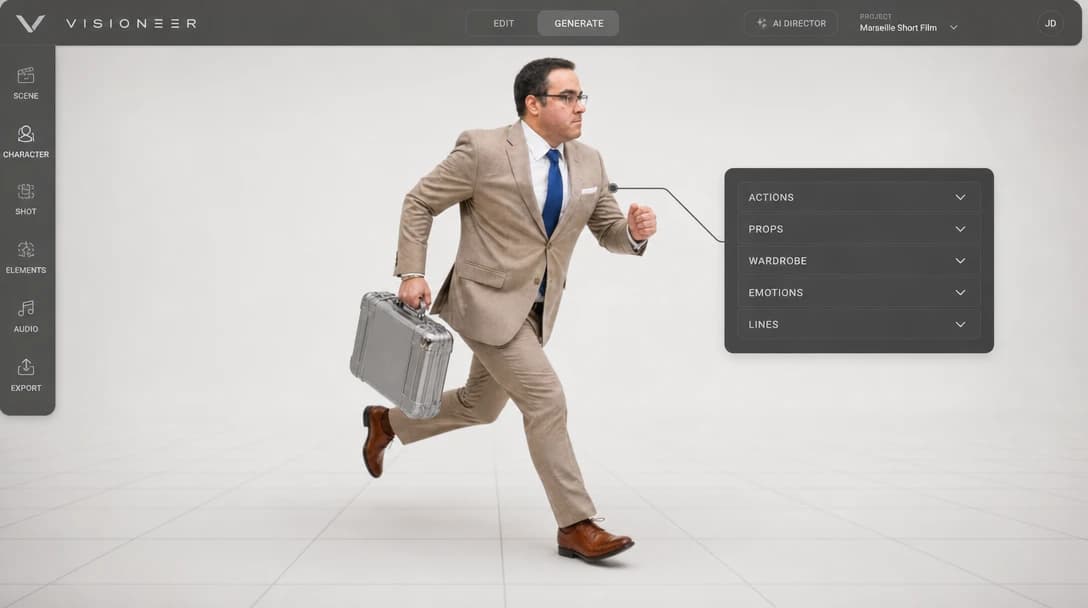
What happens when AI filmmaking needs to last longer than a few seconds?
AI video is already capable of producing extraordinary individual shots. The harder problem begins when those shots need to belong to the same film.
Characters drift. Props change shape. Costumes mutate. Locations subtly reorganize themselves. Extending a strong take can introduce new inconsistencies, and connecting one generated shot to another can require rebuilding much of the visual context from scratch.
I started exploring whether continuity could become part of the production system itself rather than something a filmmaker repeatedly fixes after every generation.
The result is a work-in-progress concept for an integrated AI filmmaking environment: one place to create recurring characters and props, maintain visual and spatial references, generate shots, and ultimately edit those shots into longer-form sequences.
A great shot is not the same as a coherent film.
Long-form filmmaking exposes problems that are easy to hide in isolated AI clips.
An individual generated shot can be visually impressive while still being nearly impossible to use in a larger sequence. A character may look slightly different from the previous shot. A recurring prop may lose important details. The dimensions of a room may change. A camera move may end somewhere that makes the next shot difficult to begin.
These problems compound as a production grows. The filmmaker is no longer only generating images; they are managing identity, objects, space, movement, references, takes, and transitions across an increasingly large body of material.
The central product question became: how might an AI filmmaking environment preserve enough production context that each new shot does not have to start from zero?
Treat continuity as a production asset.
The concept brings the pieces required for consistent AI filmmaking into a single production environment.
Instead of treating every generation as an isolated event, the production would maintain reusable information about the people, objects, and environments that make up the film.
Characters and important props become persistent production assets. Their references can be organized, refined, and reused throughout the project rather than recreated for every new shot.
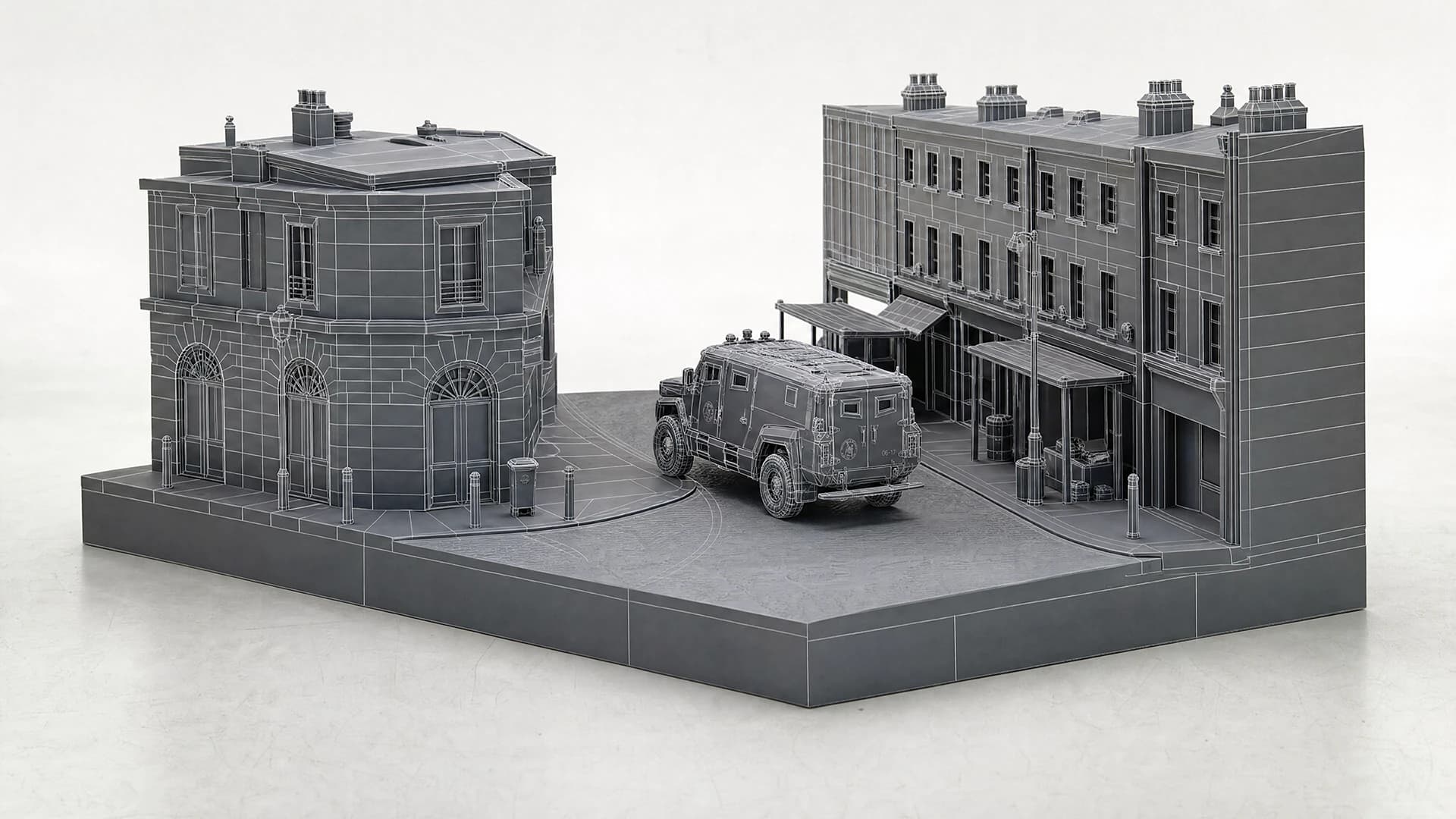
The environment also introduces 3D continuity references — lightweight spatial models used to preserve the shape, proportions, orientation, and relationships of important elements across shots.
Train the character once. Use the character throughout the film.
Recurring characters need a stronger identity than a collection of prompts and reference images.
The proposed workflow allows a filmmaker to gather approved character references and use them to create a reusable character-specific AI model.
A planned automated LoRA training workflow would handle much of the technical process behind creating those models. Rather than forcing filmmakers to leave the production environment and manage training infrastructure manually, the experience would treat model creation as part of character setup.
The intention is not to expose every underlying technical parameter. The filmmaker should be able to think in production terms: this is the character, these are the approved references, and this is the model used to reproduce that character across the project. Train a sub-model (LoRA low rank adaptation) for each character using approved reference images. The model can then be used to generate that character consistently across shots.
Give the model something stable to return to.
Some consistency problems are easier to manage when the production has a spatial reference rather than relying on images alone.
A prop, vehicle, room, or other important production element can be represented by a lightweight 3D continuity model. It does not need to become the final rendered asset. Its role is to preserve the underlying structure.
That reference can help establish proportions, camera orientation, object placement, and alternate views before generating a new shot.
The larger idea is that continuity should be something the system can remember with the filmmaker rather than something the filmmaker must repeatedly reconstruct.
From reference to shot to edit.
The long-term concept is an environment where creation and editing share the same production context.
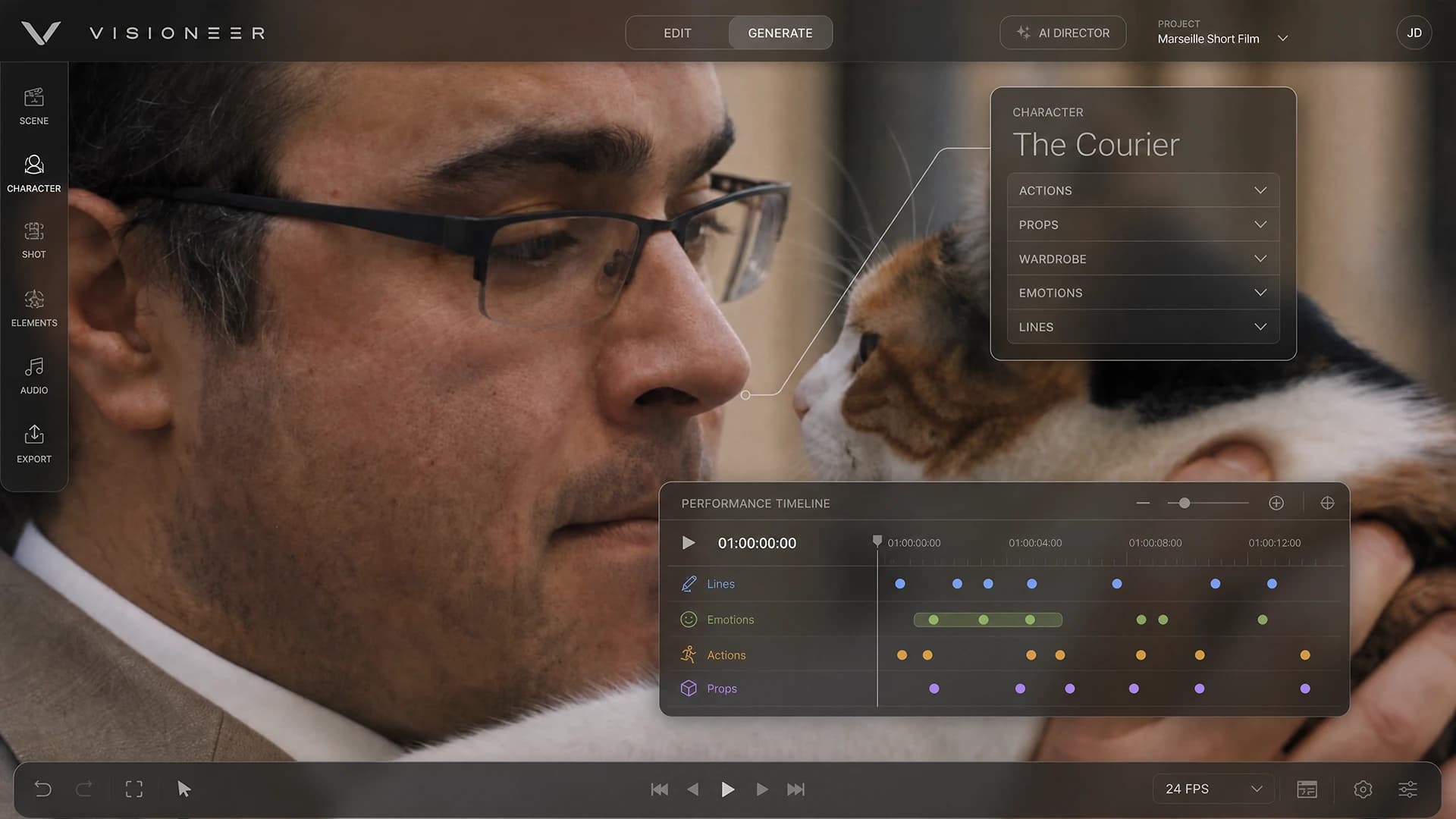
A filmmaker could establish characters, props, and locations, develop visual references, generate takes, extend promising shots, and organize the resulting footage without breaking the connection between the media and the assets used to create it.
That shared context becomes particularly important when revisiting a scene. Instead of reconstructing which references, character models, spatial guides, and previous frames were used, the production environment can preserve those relationships.
The Experience In Progress
I tested the workflow by making the film first.
Before building the complete product experience, I wanted to understand whether the underlying production approach could actually support longer-form work.
I performed much of the proposed workflow manually: maintaining references, managing continuity, generating and extending shots, iterating on problematic sequences, and assembling the footage into a larger production.
That process produced 85 minutes of cinematic footage currently being cut for release. More importantly, it exposed where the workflow becomes repetitive, fragile, or difficult to manage — exactly the areas an integrated product could begin to address.
The production is therefore both a proof of concept and a source of product requirements. The software is being designed around problems encountered while actually making something.
The workflow is proven manually. The product is not finished.
This is an active R&D project rather than a completed commercial product.
The current work includes product concepts, interface mockups, continuity experiments, and the manual filmmaking workflow demonstrated in the footage above.
The integrated experience — including automated character-model training, production asset management, continuity tools, generation, and editing — remains in development.
That distinction is intentional. The project is less about presenting a finished answer and more about showing how I explore an emerging technology, identify where the real product problems are, test ideas through making, and gradually turn those discoveries into a usable system.
The interesting problem is what happens between the shots.
Long-form AI filmmaking is not only a generation problem.
It is also an information-management problem, a continuity problem, an editing problem, and ultimately a product-design problem.
The more capable individual generation models become, the more important the surrounding workflow becomes. Filmmakers need ways to preserve decisions, reuse assets, understand what changed, and control increasingly complex productions.
That is the space I am exploring with this project: not simply how to generate another impressive shot, but how to make thousands of creative decisions add up to one coherent film.