
From unused to indispensable.
I led the redesign of Fidelity’s myCareer application, transforming a product with no measurable adoption into the most-used application in Fidelity’s internal ecosystem.

Make career development actionable.
myCareer was designed to help employees understand their options and take a more active role in their professional development.
The application supported several career paths: improving in an existing role, moving laterally into another field, advancing to a more senior position, or deepening expertise within a current career.
Employees could compare roles, identify the skills required for a desired position, and discover classes or self-guided learning resources to help close those gaps. The opportunity was to make that information understandable and useful enough for employees to return to the application.
Leading the redesign.
I managed the entire redesign process, using the findings from our usability research to guide the direction of the experience.
My responsibility was to turn the research findings into a clearer, more useful product experience, with particular emphasis on how career information and skill gaps were presented.
A valuable product that employees weren't using.
The original application had been designed by an outside firm, but it was not seeing measurable adoption.
The challenge was not simply to improve the appearance of the interface. We needed to make the product useful enough that employees would choose to use it as part of their career development.
The usability study had identified problems with the clarity of the application’s purpose, navigation, career comparisons, resources, and interaction conventions. Those findings gave the redesign a grounded starting point.
Turn career questions into clear next steps.
The redesign focused on making complex career information easier to understand and act on.
Rather than beginning with a purely visual refresh, I used the research findings to identify where the experience needed to become clearer and more useful.
The central design challenge was to help employees move from a broad question—what could I do next?—to a more actionable understanding of their options. That meant making career paths, role comparisons, skill gaps, and learning opportunities easier to interpret.
Data design was particularly important. The goal was to help employees understand where they stood, what a desired role required, and what they could do to move toward it.
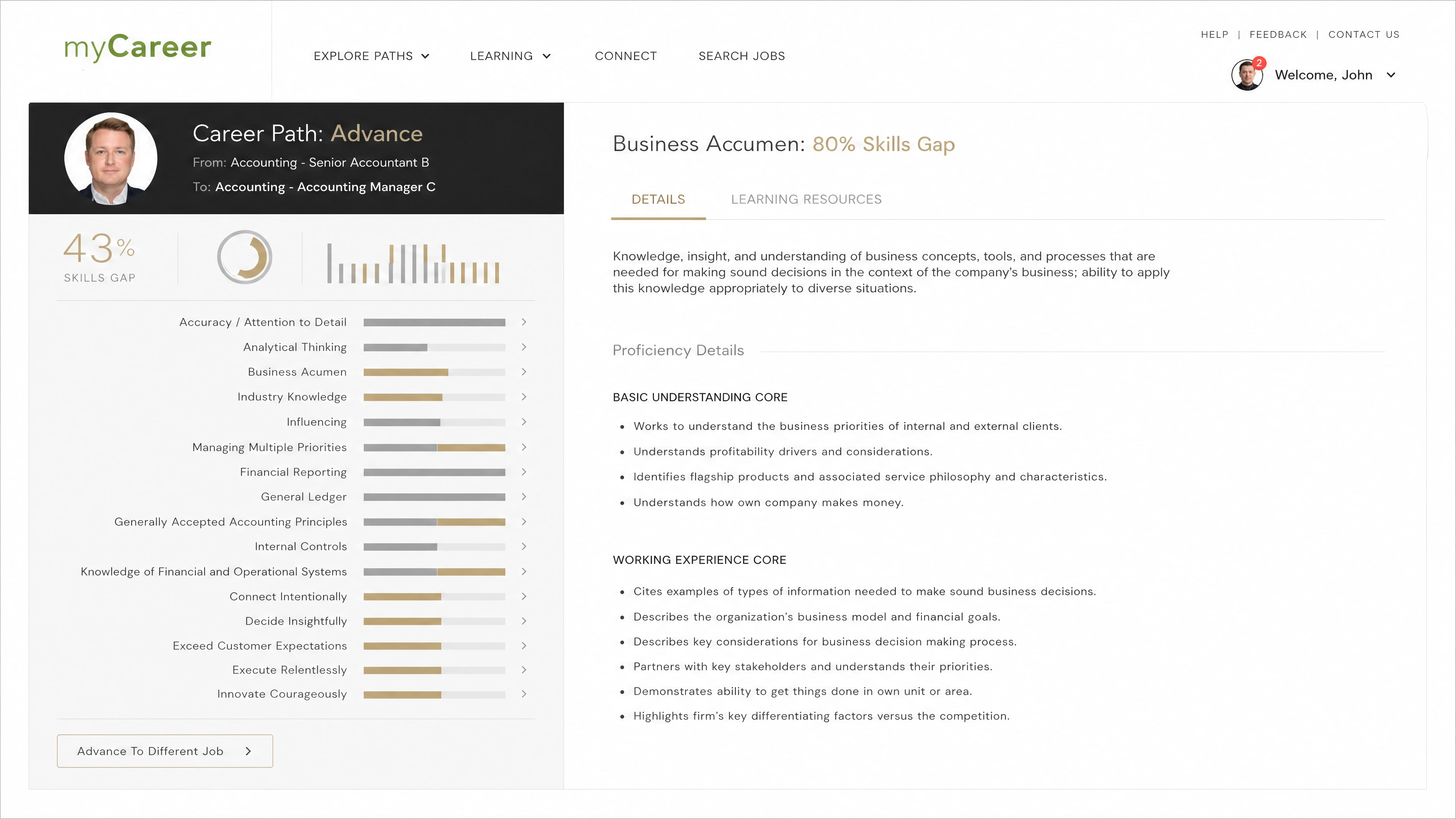
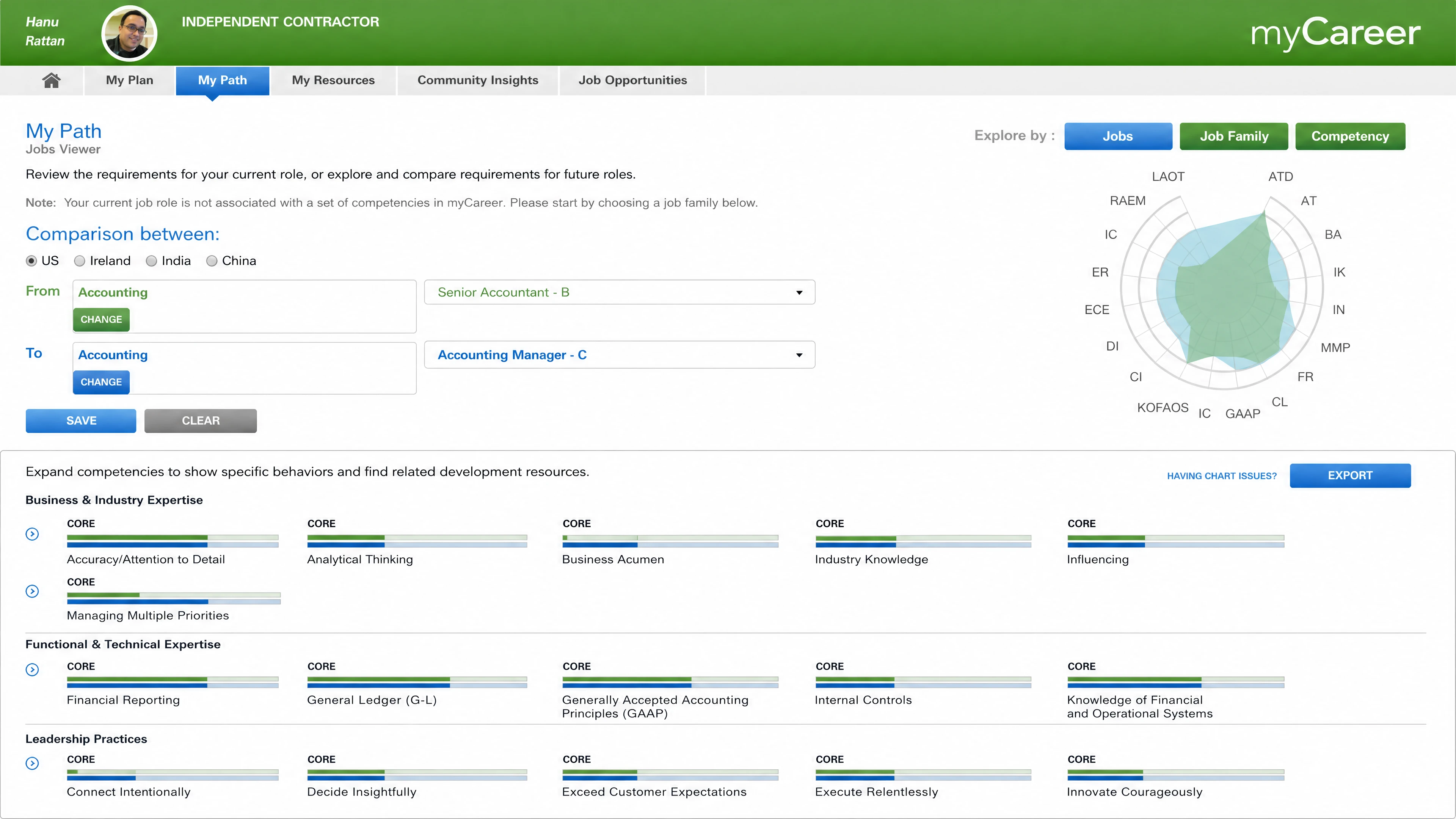
Where I am. Where I could go. What comes next.
The redesigned experience made career exploration, role comparison, and skill development more understandable and actionable.
An employee considering a move from Financial Advisor to VP of Financial Services, for example, could compare the roles, see areas where their skills needed development, and find classes or self-guided learning resources relevant to those gaps.
The design aimed to make career development feel less like an abstract aspiration and more like a path employees could understand and act on.
The final experience
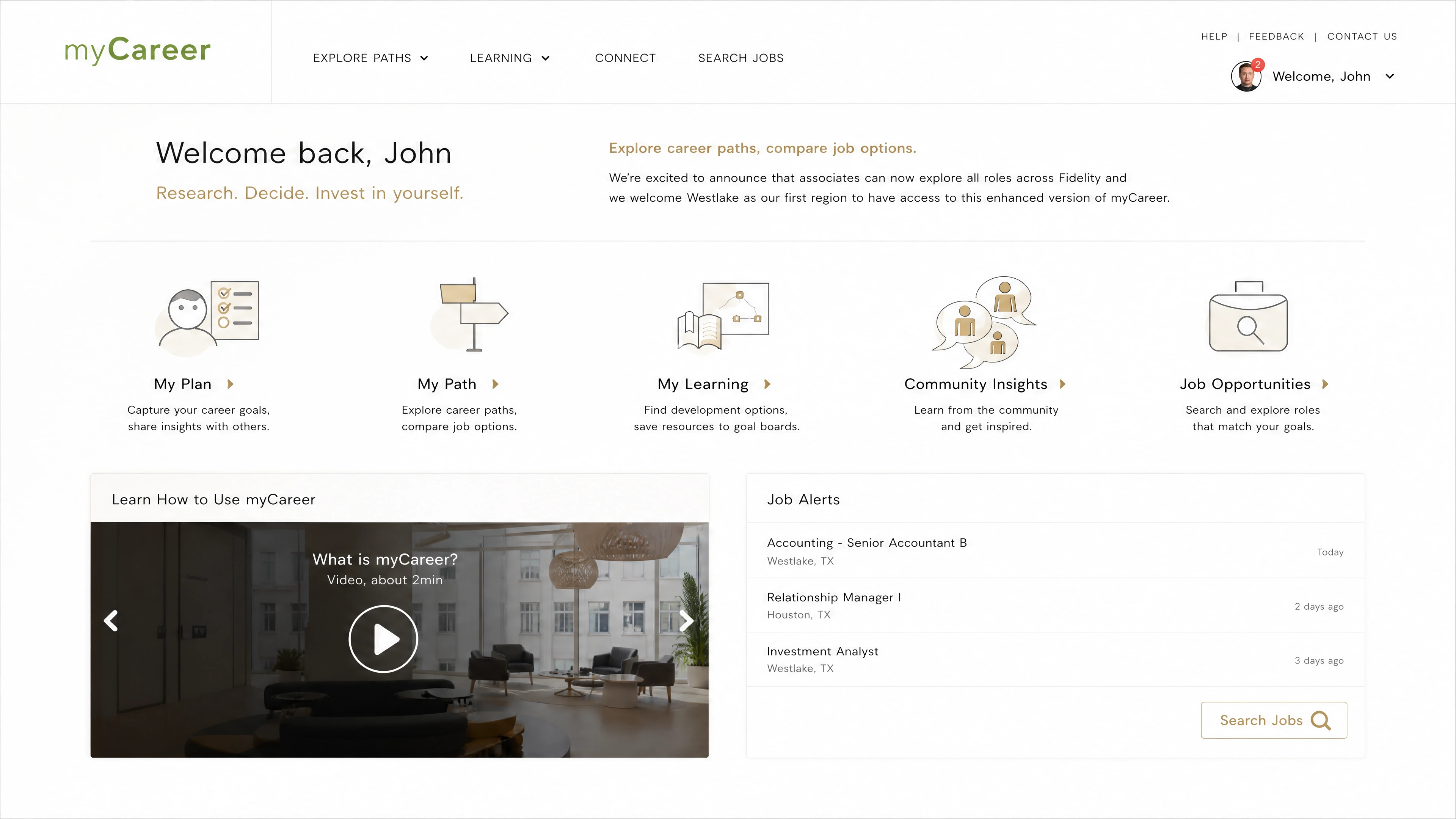
myCareer redesign based on learning from user research.
From no measurable usage to #1.
Active usage was the primary measure of success.
Before the redesign, the application was not seeing measurable adoption. Following the redesign, myCareer consistently had 10–20% of all Fidelity employees using the application on any given day.
It became the #1 most-used application in Fidelity’s internal ecosystem. That sustained adoption was the clearest evidence that the redesigned experience was providing value to employees.
The broader purpose was to help employees see opportunities for growth within Fidelity and feel more in control of their careers. While that could support retention, I would not claim a measured retention improvement without separate evidence.
Make the information useful. Measure the behavior.
The project reinforced the importance of connecting research findings to the decisions users need to make.
Career development is complex, but good data design can make it more approachable by showing employees their options, skill gaps, and next steps.
The redesign also demonstrated the value of measuring whether a product is actually being used. Its success was not simply that the interface improved, but that employees returned to it in substantial numbers.
The research and redesign together reflect how I approach product work: understand the problem, make the information useful, and measure whether the experience is delivering value.